


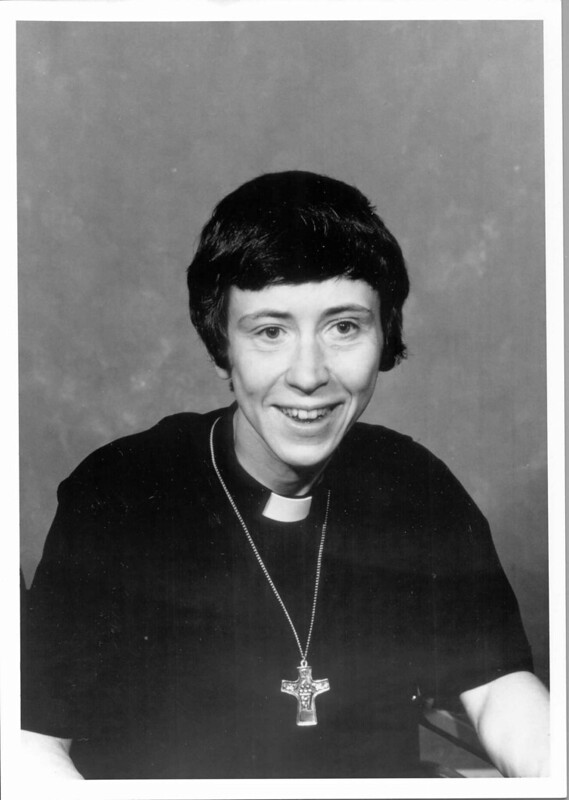
Born in Minneapolis in 1935, Barbara Andrews attended Edina Community Church as a child. Disabled by cerebral palsy, she spent her life bound to a wheel chair. Though she depended on family and friends for mobility assistance, she refused to be defined by her disability. Susan Thompson recalls blaming a mistake on her ethnicity and Andrews responding, “It’s all right to say that ‘I’m this way because I’m Norwegian.’ But when are you going to quit blaming it on being Norwegian and do something about it?”
Despite the physical obstacles, Andrews attended Gustavus Adolphus College. Friends known as “luggers” pushed her in her wheelchair to and from classes. She graduated in 1958, and today a scholarship for disabled students at Gustavus Adolphus College bears her name.
In 1962, Andrews began work as a lay pastor to students at the University of Minnesota. She continued in this position until 1969. But, in 1964, she also began work on a Masters of Divinity at Lutheran Theological Seminary, Minneapolis. One of three women in the “ordination track” at the time, she graduated in 1969. Intending to take a position as a hospital chaplain, Andrews requested a certification for ordination. The faculty of the seminary provided the certification and Dr. Alvin N Rogness wrote, “Though the Faculty cannot make any judgement as to the place she will fulfill in the Church, we find her in character and in training prepared for ordination.”
At this point in time, Lutheran churches in the United States did not allow the ordination of women, but pressure for change was mounting. In 1970, Andrews told a Minneapolis Star interviewer, “disability is not as much a handicap as my womanhood, but it’s a good back-up to arguments against employing me.” Later that year, American Lutheran Church (ALC) voted to allow the ordination of women. Andrews was already qualified. Andrews’s childhood church, Edina Community Lutheran Church called Andrews as an Associate Pastor, though it had not previously been in search of one.
By her December 1970 ordination, Andrews became the first woman ordained in the ALC (and the second American Lutheran woman ordained, after Elizabeth Platz). At her ordination, Rev James Siefkes declared, “You came rolling through the door Barbara, and you pushed it open for all the women who will follow you. The door will not close again.”
Andrews continued working as a hospital chaplain. She excelled at this work. Susan Thompson opines constantly being at eye level with patients, rather than standing above them, made her more approachable, and her inherent frailness made her more relatable. In 1972, Andrews testified before the Bill of Rights Committee of the Minnesota Constitutional Study Commission. Her testimony focused on discrimination by a taxi company that suddenly refused to transport her, even though she was capable of entering and exiting taxis on her own. She concluded:
“As a handicapped person, I am met with a variety of reactions by fellow handicapped persons. In many ways it looks like I’ve made it in both the straight and the handicapped world, which makes me both an object of pride and envy. But whatever way one looks at me, it is a misnomer. I am intelligent and well-educated and to some have achieved a certain degree of success, but all those things are being threatened by a decreasing mobility in a profession that demands mobility. ‘Hire the handicapped—it’s good business’ is only a slogan as long as there is no way to get to that job, if and when you find it.”
The commission did not recommend adding a prohibition of discrimination on the basis of disability to the Minnesota Constitution. However, the legislature added it to the Human Rights Act in 1973. Thus, the advocacy of Andrews and others paid off in Minnesota 17 years before the federal government passes the American Disability Act in 1990.
In 1974, Andrews stretched her independence further, accepting a position in Detroit at Luther Haven Nursing Home. She lived independently in Detroit until 1978, when she died in an apartment fire.
Sources:
- Wikipedia contributors. (2024, December 4). Barbara Andrews (Lutheran pastor). In Wikipedia, The Free Encyclopedia. Retrieved 21:27, December 31, 2025, from https://en.wikipedia.org/w/index.php?title=Barbara_Andrews_(Lutheran_pastor)&oldid=1261206670
- Barbara Andrews. Fifty Years On a Half Century of Ordaining Lutheran Women. (n.d.). https://pages.stolaf.edu/lutheranwomensordination/barbara-andrews-2/
- Thompson, Susan. “Barbara Andrews.” In Lutheran Women in Ordained Ministry, 1970-1995, edited by Gloria E. Bengtson, 52–58. Minneapolis: Augsburg Fortress, 1995.
- Granquist, L. (2025, May 25). Pioneering pastor struggled to find transportation. Access Press. https://accesspress.org/pioneering-pastor-struggled-to-find-transportation/