


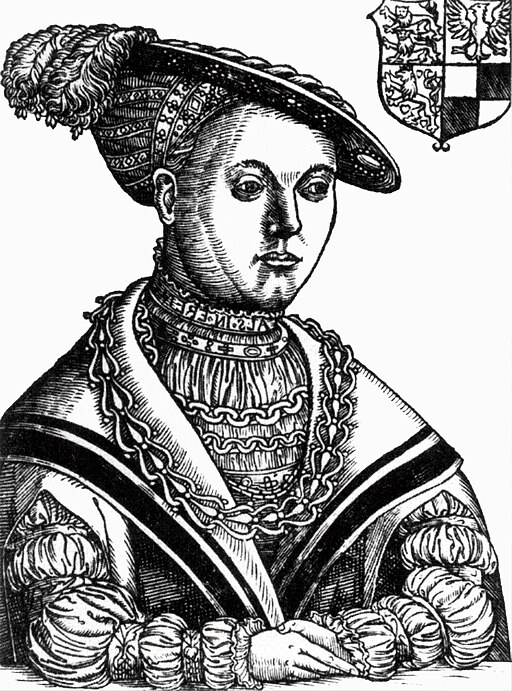
The granddaughter of King John I of Denmark, Elisabeth was born in Colin (now combined with Berlin) in 1510 to Elector Joachim I of Brandenburg and his wife, also named Elisabeth. Young Elisabeth received a religious and humanist education extensive enough to include Latin.
In 1525, at the age of 14, Elisabeth married the much older Duke Eric I Brunswick-Göttingen-Calenberg. Two years later, Elisabeth’s mother openly converted to Protestantism, after which Joachim asked a church council if he should divorce, execute, or imprison his wife over her religious convictions. The elder Elisabeth escaped to the court of her uncle, the Elector of Saxony.
In 1534, Elisabeth met Martin Luther while visiting her mother at Lichtenberg Castle. By 1538 Elisabeth and Martin had established a regular correspondence. As part of that correspondence, he sent her a copy of his German translation of the Bible. That same year, Elisabeth publicly demonstrated her conversion to the Lutheran faith by accepting “communion under both kinds.” This meant that she took both bread and wine at communion. In the Catholic church, communion for the laity consisted only of bread, with wine reserved for the clergy alone. Luther’s reforms included opening full communion to everyone. Fortunately for Elisabeth, her husband, Eric I, chose to tolerate her conversion, though he himself remained Catholic. At Elisabeth’s request, Phillip of Hesse sent Lutheran preacher and church administrator Anton Corvinus to Münden, a town within her dower estates.
When Eric I died in 1540, his heir Eirxc II was only 12 years old. Eric I’s will appointed Elisabeth as regent or co-regent, a position not often filled by a woman. Sources differ as to whether she served as co-regent with Phillip of Hesse, or as regent alone with Phillip of Hesse and two other men appointed as her guardians. Either way, Elisabeth served as the primary administrator, as the regent on site, for five years. During this time, she replaced administrators with Lutheran reformers. In 1542, she issued a Church Order, officially changing the churches and monasteries within the duchy to Protestantism. Elisabeth also wrote a manual on the administration of the duchy to pass on to her son when he reached his majority.
In 1546, after her son Eric II became old enough to officially serve as Duke, Elisabeth remarried, taking Count Poppo XII of Henneberg as her new husband. Meanwhile, Eric II sought the political favor of the Holy Roman Emperor, Charles V. Eric II reverted to Catholicism both personally and politically. He imprisoned Anton Corvinus and other reformers. Elisabeth managed to remain in Münden until 1553, but ultimately relocated to Henneberg. There, she wrote a book of advice for widows. The Herzog August Library owns a well preserved copy of this manual printed in 1598. After Elisabeth died in 1558, her children commissioned an epitaph for her in her second husband’s family burial place, St. Giles Chapel of the St. John’s Church in Schleusingen.
Sources:
- Wikipedia contributors. (2025, August 14). Elisabeth of Brandenburg, Duchess of Brunswick-Calenberg-Göttingen. In Wikipedia, The Free Encyclopedia. Retrieved 17:01, August 27, 2025, from https://en.wikipedia.org/w/index.php?title=Elisabeth_of_Brandenburg,_Duchess_of_Brunswick-Calenberg-G%C3%B6ttingen&oldid=1305919308
- Lebensgeschichte von Herzogin elisabeth. Lebensgeschichte – Herzogin Elisabeth. (n.d.). https://herzogin-elisabeth.de/lebensgeschichte.html
- Bainton, R. H. (2007). Women of the Reformation in Germany and Italy. Fortress Press.
A note from the author: In different sources Elisabeth and her mother are each referred to as “Elisabeth of Brandenburg.”