


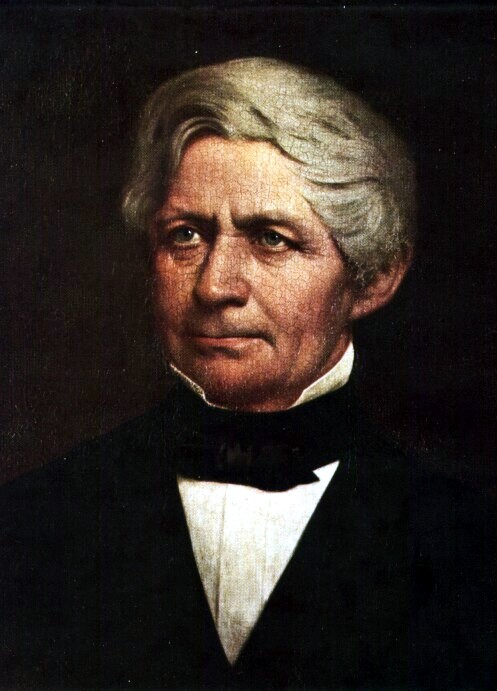
Born in Hamburg in 1808, Johann Hinrich Wichern was the eldest of seven siblings. His middle class upbringing included attending a private school. However, upon the death of his father the family’s circumstances changed. Thus, Wichern started working as a private tutor at the age of 15 to support his family. Eventually, he did complete his high school work, and earned a scholarship to study theology in Göttingen and then in Berlin. Then, Wichern returned to Hamburg as a candidate for ordination.
During his time in Hamburg, Wichern grew concerned for the underprivileged children he saw on the streets. Wichern wanted to create a nurturing environment that would raise responsible citizens and good Christians. Accordingly, in 1833, he secured donations from benefactors and opened Rauhes Haus (Rough House) on a farm in the nearby village of Horn. Rough House housed children in groups of twelve with adult mentors. Initially, it served boys, but eventually expanded to serving girls as well. The children attended school, did chores, and learned practical skills. By 1842 Rough House had grown so much that Wichern created a training institute for the adult assistants. Thus, the social service work performed at Rough House became a professional career.
Legend holds that in 1839, a child at Rough House asked every day if Christmas had arrived. In response, Wichern placed 24 small red candles and 4 large white candles on a cart wheel. Each Sunday in Advent they lit a white candle, and on the other days, they lit a red candle. Thus, the light grew as the calendar approached Christmas day. In time, this candle based Advent calendar caught on in Germany and evolved into the simper Advent wreaths that we have in churches today.
During this time, as industrialization spread, class divisions in Germany grew. In 1848, Marx and Engels published The Communist Manifesto. Protests over unemployment, censorship, and the autocratic government spread through the lands that are now Germany and Austria. That same year, Wichern spoke at the First Congress of the Evangelical Churches in Wittenberg. He introduced his Inner Mission concept. Wichern saw a need for the church to address growing issues of poverty. Organizing regular people to tackle the issue was a natural extension of the Reformation concept the priesthood of all believers. Additionally, Wichern feared Communism’s antagonism toward religion and wanted the church to be a solution to class conflict instead of the enemy of the working class. Consequently, the Central Committee for the Inner Mission of the German Protestant Church” was founded in 1849.
Wichern continued his social work expanding Rough House and engaging in prison reform until he retired in 1872, due to poor health. Following several strokes, Wichern died in hamburg in 1881.
Sources:
- Wikipedia contributors. (2023, March 9). Johann Hinrich Wichern. In Wikipedia, The Free Encyclopedia. Retrieved 03:22, December 18, 2025, from https://en.wikipedia.org/w/index.php?title=Johann_Hinrich_Wichern&oldid=1143661624
- Wikipedia contributors. (2025, September 15). Advent wreath. In Wikipedia, The Free Encyclopedia. Retrieved 03:23, December 18, 2025, from https://en.wikipedia.org/w/index.php?title=Advent_wreath&oldid=1311404466
- Wikipedia contributors. (2025, September 15). Advent wreath. In Wikipedia, The Free Encyclopedia. Retrieved 03:23, December 18, 2025, from https://en.wikipedia.org/w/index.php?title=Advent_wreath&oldid=1311404466
- Zurawski, N. (2024, October 1). Johann Hinrich Wichern: Der Umtriebige Theologe Erfindet in Hamburg den adventskranz. ndr.de. https://www.ndr.de/geschichte/koepfe/Johann-Hinrich-Wichern-Menschenretter-und-Adventskranz-Erfinder,wichern34.html
- (n.d.). The Inner Mission (by Johann Hinrich Wichern and Theodor Fliedner) Summary. YouTube. https://www.youtube.com/watch?v=Aqmfr2Rh31k
- Johann Hinrich Wichern – search results provided by. (n.d.). https://www.biblicaltraining.org/library/johann-hinrich-wichern