


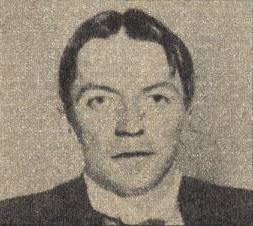
Kaj Harald Leininger Petersen was born in Maribo, Denmark on January 13, 1898 to Carl Petersen, a tanner, and his wife Mathilde. Following the death of Carl in 1899 and Mathilde in 1903, Kaj went to live with Peter and Marie Munk in Opager,about 10 miles from Maribo, and took on their last name, becoming Kaj Munk.
In 1917, Munk entered the University of Copenhagen to study theology. He also wrote his first play that year, a Biblical drama titled Pilatus. In 1924, Munk graduated from the University of Copenhagen with a degree equivalent to a Masters in Theology. He then accepted a position as pastor at a church in the town of Vedersø. While pastor, he also continued his playwright career. His theatrical breakthrough came in 1931 when The Royal Danish Theatre staged his play Cant, about Henry VIII. Further success followed in 1932 when Ordet appeared at the Betty-Nansen Theater. Ordet would be adapted into a movie in 1933 and again in 1956.
When Hitler came to power, Munk initially expressed admiration for the way he unified Germany and romanticized the idea of a unifying Nordic dictator. He was, however, horrified by Germany’s treatment of Jews as well as Mussolini’s invasion of Ethiopia, and became an outspoken critic of the Nazi regime. The plays he wrote during the German occupation of Denmark criticized Nazism. His sermons frequently criticized Danish Nazi collaborators.
In the early years of the German occupation of Denmark, the Danish government generally cooperated with the Nazis. But, by the summer of 1943 public sentiment about this arrangement deteriorated, Resistance through strikes, sabotage, and riots spread through Denmark. Then, in August of 1943, the Danish government disbanded. The Army and Navy ordered the destruction of ships and munitions, lest they fall into German hands. In battles over the German takeover of the Danish military forces, Danish soldiers and civilians died. Afterward, Munk wrote the poem “De Faldne” in their memory. Today, war memorials across Denmark feature the first stanza of the poem. The English translation is approximately, “Boys, you boys who died, You lit a bright dawn for Denmark in the deepest darkness.”
Meanwhile, Munk continued to speak out against the occupation, declaring. “If I were to stand as a passive observer, I would be a traitor to my Christian faith, to my Denmark mentality, and to my oath as a minister. It is better for Denmark’s relations with Germany to be damaged than for her relations with Jesus to be damaged.” Importantly, Musk’s sermons advocated for a Good Samaritan approach where Danes love and support fellow human beings regardless of religion or ethnicity, not for a church controlled state. On January 4th, 1944, Munk disappeared. His body appeared the next day. News of the assassination of the pastor and playwright spread. Despite the political danger, four thousand people lined up to mourn as his body was taken to his church in Vedersø for burial.
Sources:
- Wikipedia contributors. (2025, May 14). Kaj Munk. In Wikipedia, The Free Encyclopedia. Retrieved 03:15, August 20, 2025, from https://en.wikipedia.org/w/index.php?title=Kaj_Munk&oldid=1290390537
- Gemzøe, A. (2023). Kaj Munk’s ‘De Faldne’: Memorial Poem and Monument Inscription. Scandinavistica Vilnensis, 17(1), 45-71. Article 3. https://doi.org/10.15388/ScandinavisticaVilnensis.2023.4
- Heinrich, S. (n.d.). Commemorating Kaj Munk. Pietisten. https://pietisten.org/xiv/2/kajmunk.html
- The Kaj Munk Research Center – Aalborg University. (n.d.). https://web.archive.org/web/20110718113424/http://www.kajmunk.hum.aau.dk/en/?show=chronology
- The August Uprising 1943. kb.dk. (n.d.). https://www.kb.dk/en/inspiration/liberation/august-uprising-1943
- Thompson, L. S. (1944). A Voice Death Has Not Silenced. Books Abroad, 18(2), 126–127. https://doi.org/10.2307/40084473
- Axelssonby, G. (n.d.). Kaj Munk, Danish pastor, slain; incurred Nazi wrath for writings; body of Patriot is found near German headquarters — murder fans country to new wave of hatred for invader – the new york times. New York Times. https://www.nytimes.com/1944/01/06/archives/kaj-munk-danish-pastor-slain-incurred-nazi-wrath-for-writings-body.html