


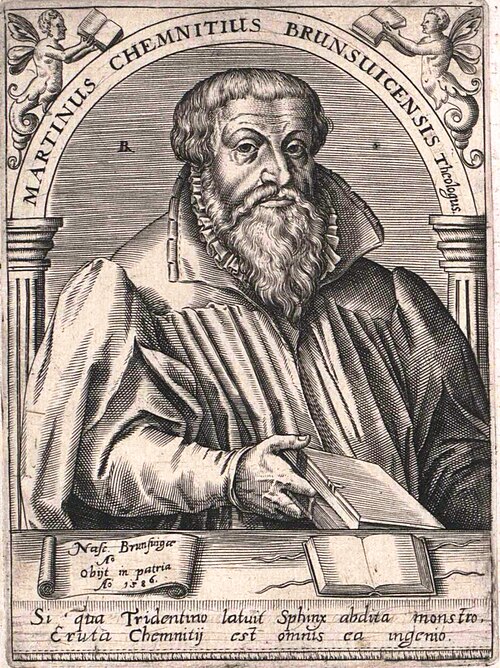
Born on 9 November 1522 in Treuenbrietzen, Brandenburg (present-day Germany), Martin Chemnitz was the third and final child of wool merchant Paul Chemnitz. Paul Chemnitz ran a prosperous business, but the family’s finances deteriorated after Paul’s death around 1533.
Chemnitz showed promise as a student, and learned Latin while in school at Madgeburg. Upon graduation, he worked as a weaver’s apprentice and helped the family business for several years. Then, in 1542, Chemnitz returned to education, enrolling at the University of Frankfurt. Unfortunately, he exhausted his finances and took on both a teaching and a tax collection job in Wriezen.
In 1545 he enrolled at the University of Wittenberg. There, he studied under Philip Melanchthon (1497-1560) and heard lectures by Martin Luther (1483-1546). However, he later admitted that he did not “attend to Luther with due diligence” at the time. The turmoil of the times (including the Schmalkaldic War) led him to move to Königsberg (in Prussia) where he earned a Master of Arts in 1548.
In 1550 he became librarian at the ducal and university library in Königsberg for Duke Albert of Prussia. That position gave him access to one of the best libraries of the day and allowed him to devote himself to self-study in theology: Hebrew and Greek, Scripture in original languages, and the early Church fathers.
Returning to Wittenberg in 1553, Chemnitz joined the faculty in January 1554 and lectured on Melanchthon’s Loci Communes. In November 1554 he was ordained by Johannes Bugenhagen, and soon thereafter was appointed co-adjutor to Superintendent Joachim Mörlin at Braunschweig (in the Duchy of Brunswick-Wolfenbüttel). In 1567 Mörlin resigned and Chemnitz succeeded him as superintendent of the churches of Braunschweig Chemnitz held this post until his health failed near the end of his life. Chemnitz firmly established the church in Brunswick-Wolfenbüttel as Lutheran. He also helped Duke Julius of Brunswick-Wolfenbüttel, establish the University of Helmstedt.
During this time following Martin Luther’s death in 1546, Lutheranism grew, but also formed factions with theological disagreements. Some wanted to reconcile Lutheranism with other protestant groups such as the Calvinists, despite fundamental theological imcompatibility. Chemnitz prized doctrinal clarity over political expediency.
Following the reveal of a plot to manipulate August, Elector of Saxony into Calvinism, August wanted to unify Lutheranism. August asked Chemnitz and Jakob Andrae, as well as others such as Nikolaus Selneker, to work together to document the Lutheran doctrine. Together, the group produced the Formula of Concord in 1577 and published the Book of Concord in 1580, formulating a clear Lutheran doctrinal identity. Chemnitz’s reputation for combining rigorous scholarship with a pastoral heart proved critical to this endeavor.
A prolific writer, Chemnitz other significant work includes Examen Concilii Tridentini (1565-1573 examining the decrees of the Council of Trent (1545-1563), and Loci Theologici (posthumously published 1591), based on his Wittenberg lectures covering a wide range of topics such as God, sin, the Church, and sacraments. He sought clarity, accuracy, and continuity with the historic Church, always grounding his work in Scripture and the tradition of the Church fathers.
Survived by his wife Anna and six of his children, Chemnitz died on April 8, 1586, at the age of 63.
Chemnitz is often called “The Second Martin” in recognition of his central role in consolidating and transmitting the Lutheran Reformation. A frequently cited saying was: “Si Martinus non fuisset, Martinus vix stetisset” (“If the second Martin had not come, the first Martin would scarcely have stood”). His theological legacy continues to influence Lutheran churches worldwide. The Book of Concord remains a confessional standard, and Chemnitz’s works have been translated into many languages. He served as an example of scholarly rigor, pastoral heart, and doctrinal stewardship in a time of turbulence.
Sources:
- Wikipedia contributors. (2024, June 15). Martin Chemnitz. In Wikipedia, The Free Encyclopedia. Retrieved 22:53, November 12, 2025, from https://en.wikipedia.org/w/index.php?title=Martin_Chemnitz&oldid=1229144023
- Martin Chemnitz at 500: Life. Concordia Historical Institute. (2022, October 6). https://concordiahistoricalinstitute.org/martin-chemnitz-at-500-life
- Lackey, M. (2024, July 11). Our great heritage: Martin Chemnitz. The Lutheran Witness. https://witness.lcms.org/2024/martin-chemnitz/